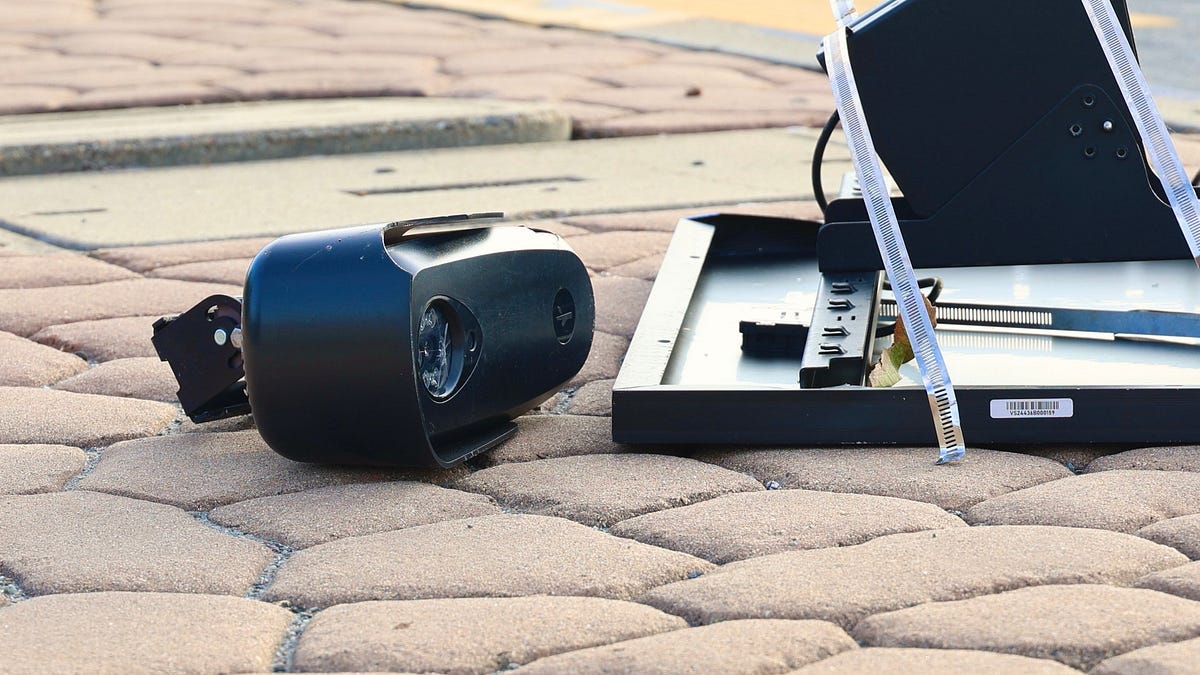
Anger over ICE connections and privacy violations is fueling the sabotage. PLUS: 10,000 drivers call on Uber to repay stolen wages, a man is arrested at a public hearing about a data center and more.
A city near me has installed a device that tracks vehicles based on their tpms (Tire Pressure Monitoring System) sensors.
All cars after 2008 in the US have TPMS. Inside the tire, integrated with the vale stem, are little pressure sensors with a radio that broadcasts on the 315Mhz band. Each one uses a slightly different frequency so that your vehicle can tell which of the four tires is low.
So each vehicle in the US made after 2008 has four unique radio signals being broadcast from it, and now there are police departments with equipment that can track those signals, and can assign each car a signature based on the frequencies the sensors are broadcasting on.
Well, from my knowledge, the person you replied to is inaccurate. All tires will transmit at the same frequency. But every X seconds, when each tire transmits its data, it transmits an ID unique to its transmitter with it.
Every X seconds is pretty generous. My Subaru only seems to poll the sensors every few minutes, and only when the wheel speed is above 35 MPH or so, at least via what I’ve observed with my diagnostic tool. The sensors are battery powered and I suspect the low refresh rate is a deliberate gambit to conserve battery life.
You are correct on the ID point, though. They can contain up to 16 hexidecimal digits as far as I’ve seen, and while there doesn’t seem to be any mechanism for truly enforcing uniqueness the chances of an ID collision are so low that you may as well consider it impossible. Some aftermarket sensors can be wirelessly reprogrammed with an arbitrary ID, though, which may be of marginal utility for the truly paranoid. (My diagnostic tool can do this, too. The intended use case is cloning the ID from an OEM sensor for a car whose TPMS relearn procedure is more trouble than it’s worth.)
Regardless of your vehicle’s polling frequency, most sensors can be woken up any time by a specific radio pulse, which my diagnostic tool can also do, and the range is surprisingly long. Just my car’s own BMS where the receiver is (above the rear left wheel well) can pick up the sensors in my snow tire rims even when said rims are sitting in their storage rack inside my garage, about three car lengths away.
If my memory serves well, it is configurable. I say X seconds because it can be 5, 10, 30, but of course also 60, 120… This is my programmer brain talking :)
Thanks for the comment though. Much more complete than mine.
can’t believe i’m quoting a transformers fanfic but here we are…
“Hang on,” Wheeljack said, “I’d worry about passive systems, not active. This mech wasn’t exactly enthusiastic about where he was going. I’d bet on some kind of system he wouldn’t be able to control at all—better yet, something that doesn’t rely on power or signal at all. Something he couldn’t rip out, or block by hiding—”
Hook and Scrapper had come over. “Exterior composition,” Scrapper said instantly. “I’ve thought of doing something of the sort for transport containers—stripe the cladding with varying amounts of a neutrino-scan-visible material for tracking, even underground. Megatron, if that’s the method they’ve used, we don’t have enough appropriate materials to block it. They’ll be able to locate him with satellite scanners, and they’re certainly sweeping for us already. We’ve got to dispose of him at once. Ideally, by melting him down.”
“Hey!” Ratchet stood up. “How about we don’t jump to slagging one of my patients!”
Hook stared at him as if he was insane. “What melodramatic nonsense. You’ve never even spoken to him!”
“He’s on my table, he’s my patient!” Ratchet said.
“Enough,” Megatron said. “Offer me a rational alternative, or shut up.”
Great, that wasn’t pressure or anything. “Fine, how about this: destroying him is stupid,” Ratchet said. “We still don’t know basically anything about this planet, we’ve nearly been taken down twice already, and now they know for sure we’ll be trying for the Excelsior, which means they’re going to be waiting for us there with everything they’ve got. We need intel, and he’s probably got it.” Megatron’s face didn’t change, but he kept listening, at least. “And we don’t need to cover him head to toe with palladium sheathing. We just need to make sure he doesn’t match the pattern they’re scanning for.”
“Well?” Megatron said to Scrapper.
“We’d have to isolate the material they used… but I suppose Mixmaster could analyze a panel of his frame,” Scrapper said grudgingly. “We could disguise him…”
“Except then they will find a pattern here that doesn’t match anything in their database,” Hook said.
“Yeah, but they can’t have a negative-match process,” Wheeljack put in. “They’re not energy-bound, right? They’re materials-bound. That’s why they—recycle instead of smelt down. Any one of their mechs is probably carrying a dozen old parts, and you’d get a negative match any place two patterns overlap. They probably just make sure each new mech gets at least some parts in a unique pattern, and that’s what they’ll be looking for.”
but if there’s also cameras everywhere then every time a negative match comes out then it just triggers the cameras to pick out those cars. best bet would be collectively agreeing to use one set of specific id for everyone, not a randomized id and thus unique id’s


A city near me has installed a device that tracks vehicles based on their tpms (Tire Pressure Monitoring System) sensors.
All cars after 2008 in the US have TPMS. Inside the tire, integrated with the vale stem, are little pressure sensors with a radio that broadcasts on the 315Mhz band. Each one uses a slightly different frequency so that your vehicle can tell which of the four tires is low.
So each vehicle in the US made after 2008 has four unique radio signals being broadcast from it, and now there are police departments with equipment that can track those signals, and can assign each car a signature based on the frequencies the sensors are broadcasting on.
That’s alarming, but how much can these really vary? I’d be surprised if a lot of vehicles weren’t the same.
Well, from my knowledge, the person you replied to is inaccurate. All tires will transmit at the same frequency. But every X seconds, when each tire transmits its data, it transmits an ID unique to its transmitter with it.
Every X seconds is pretty generous. My Subaru only seems to poll the sensors every few minutes, and only when the wheel speed is above 35 MPH or so, at least via what I’ve observed with my diagnostic tool. The sensors are battery powered and I suspect the low refresh rate is a deliberate gambit to conserve battery life.
You are correct on the ID point, though. They can contain up to 16 hexidecimal digits as far as I’ve seen, and while there doesn’t seem to be any mechanism for truly enforcing uniqueness the chances of an ID collision are so low that you may as well consider it impossible. Some aftermarket sensors can be wirelessly reprogrammed with an arbitrary ID, though, which may be of marginal utility for the truly paranoid. (My diagnostic tool can do this, too. The intended use case is cloning the ID from an OEM sensor for a car whose TPMS relearn procedure is more trouble than it’s worth.)
Regardless of your vehicle’s polling frequency, most sensors can be woken up any time by a specific radio pulse, which my diagnostic tool can also do, and the range is surprisingly long. Just my car’s own BMS where the receiver is (above the rear left wheel well) can pick up the sensors in my snow tire rims even when said rims are sitting in their storage rack inside my garage, about three car lengths away.
If my memory serves well, it is configurable. I say X seconds because it can be 5, 10, 30, but of course also 60, 120… This is my programmer brain talking :)
Thanks for the comment though. Much more complete than mine.
can’t believe i’m quoting a transformers fanfic but here we are…
but if there’s also cameras everywhere then every time a negative match comes out then it just triggers the cameras to pick out those cars. best bet would be collectively agreeing to use one set of specific id for everyone, not a randomized id and thus unique id’s