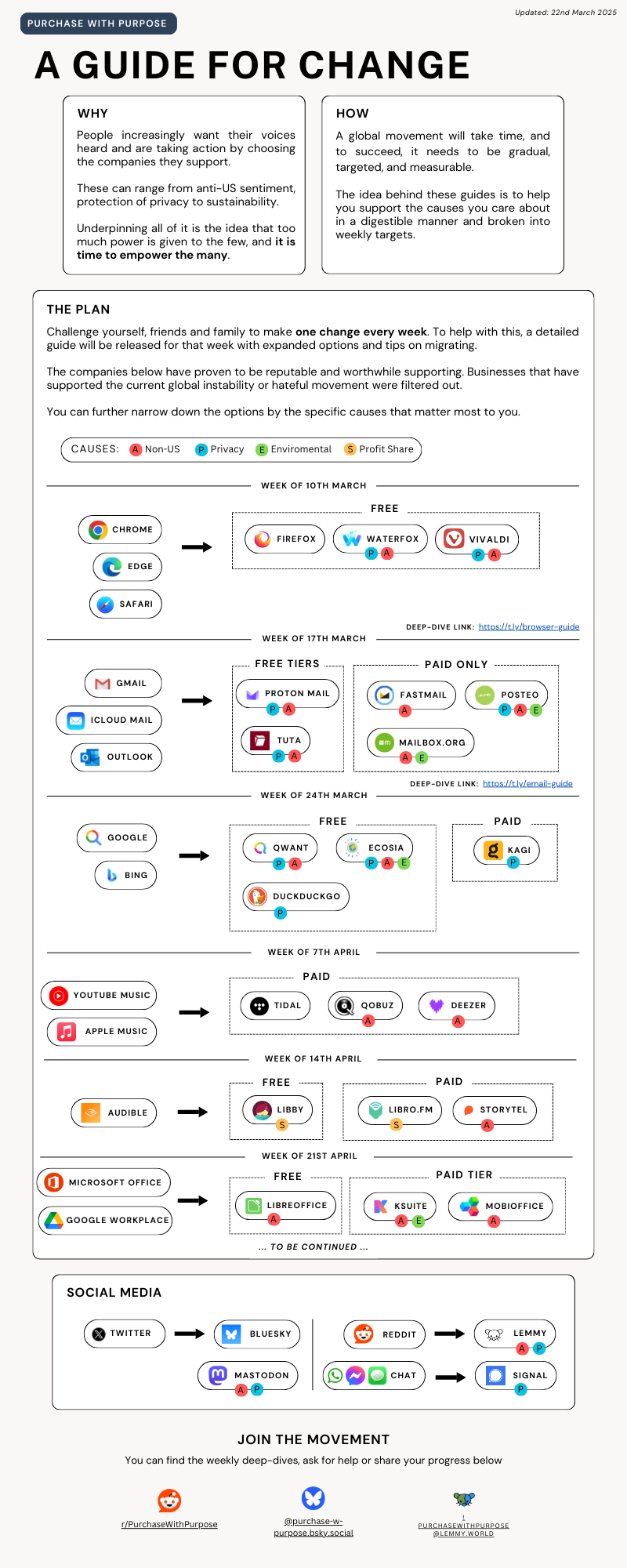
Kagi will let you block slop sites (but you have to manually block each one)


Kagi will let you block slop sites (but you have to manually block each one)


Hot take, I don’t mind it - my drawer of questionably compliant OEM cables is overflowing. Less plastic waste is a win, as long as everyone sticks to USB-C.


Is your favorite color purple?


A capacitor has ~1% of the storage capacity of a battery of similar power rating.
Saying its storage performance is better because its holds a larger % of that capacity at low temperatures is nonsense because its storage performance objectively sucks (and not what it’s designed to be good at)
It’s like saying a Tesla is better than a 747 because it can go from 0-60 faster. A technically true statement but a meaningless performance comparison.


30-50% of my energy is the EV. About 20% is 120V plug loads (computers, fridges, home server), ~5-10% lighting, ~15% large equipment (dryer, electric range, electric water heater), and the remainder (15-30% seasonally) is HVAC (heat pump)
Any gas appliances would bring a lot of those numbers down


American House with an EV, all electric, and no solar, I use about 1200 kWh/mo (1.2 MWh/mo) on average. This could only carry me through about 3y. Even if I had access to good public infrastructure I think best I could do is 6y (again, all-electric home).
But I digress. Lithium ion as purely load shifting is a pretty reasonable, I’d argue critical, solution for covering day/night loads, but starts to fall apart completely when it comes to seasonal (summer/winter) loads.
But what makes this plant interesting is the addition of super capacitors. The combo battery/SC plant is less about day/night load shifting and more about providing stability to a shifting grid. As supply and demand grow increasingly decoupled, and we try and shift away from expensive peaker plants always on standby, systems like this can dramatically help smooth grid performance.
~90 MW of peaker capacity is small potatoes currently, but this is a big step towards a more reliable grid future.


Supercapacitors provide ultrafast response times – specified at 0.001 seconds – and maintain over 85% capacity at –40°C, significantly outperforming lithium-ion batteries in extreme cold.
Outperform how? At being a capacitor? That’s their whole point.
On the energy side, 85% of 29 MW-min is 0.41 MWh. Even if the batteries lose 99% of their capacity at -40 °F, last I checked .42 MWh > 0.41 MWh.
These are two different tools for two different purposes, I’m not sure how you compare their “performance” under this metric.
I’ll run a backup and restore when moving to a new device, because why not. But regular backups? Meh, the ether can have my messages if my phone dies.
That said, depending on how this new system is rolled out, I may subscribe just to support the Signal foundation.


You do you - anything is technically possible, and from a purely engineering perspective a Steam Deck is an impressive little piece of hardware.
That said. I would advise against getting it for any sort of productivity. Having to haul out it, a separate keyboard, and mouse, just to take a quick note in class is cumbersome and distracting, even if we assume everything works on the first go every time (it won’t.).
As others have pointed out, Linux is nice until it isn’t - maybe you can partner up with a friend when your chemistry lab needs you to reference their archaic software to find some material property, but its a risk you’re choosing to take on. Will it pair with the campus printers? What if you need to run Solid Works? Ansys? The drivers for a digital microscope? Collaborating on group projects in Microsoft Office (the web apps aren’t the same.)? The list goes on.
Additionally, something like the Steam Deck is built for gaming. Meaning every time you pick it up, it reminds you it’s time to game. As someone with ADHD who struggled to stay on task in college, having a constant reminder of distractions at my fingertips would have been overwhelming.
That’s before we factor in the ‘cool’ factor of being that person in the class.
Get a laptop.


This is the Spotify/Apple Music/etc model and the reason why music piracy is practically dead (yes, I know there are a few sites still going).
These services are doing their best to find ways to push people back to piracy but for now they keep it at bay through competition to provide better service.
If there was a catchall video streaming service where all publishers released and got a cut of their plays it would be game over for piracy. Fortunately that’ll never happen.


With 99+% of hashes matching?
Whatever the issue, theres good odds that the pieces with matching hashes are perfectly fine and the <1% of pieces with errors OPs bittorrent client can and did replace, so now the files are identical to source and good to go!


(I get that corporate environments are often off the table for this).
FYI in case anyone needs to hear this, but Firefox can be installed as a user in windows if you just decline the admin prompt when installing.


If you checked the torrent file and it’s showing 99+% that means you almost certainly have the right file but some minute piece of metadata is off. Good news is now you only have to snag ~1% of that file from the seeders that pop in an out and you’ll be set.


Who the fuck doesn’t like NPR?


Looks like exactly the kind of thing I’ve been looking for - a clean and easy to use SSH manager!
One question: how are SSH credentials stored? Is there any option for password protection?
And one feature request: as a long time MobaXterm user on Windows, one feature I’ve yet to see in a Linux SSH utility is the “multi-execution” mode which let’s you send commands to multiple terminals at once.
Pizza’s core implementation is in C though. It’s just a fancy way to call C libraries.
Today I learned pepperoni is a C library.


Tell me more about these cow orks.
On what exactly? If you work for a 3-letter government agency and your laptop was a gift from your new friend Sergei Notaspy who you met on vacation in Moscow?


We created a totally secure and definitely unguessable (Probably Unique)™ identifier system - an MD5 hash of FirstnameLastname-DOB
Oh also with this new totally flawless system, you’re now legally obligated to recite I’m full your (Probably Unique)™ 32-character hash to any ICE agents who request it. Failure to do so will result in detainment.
For immigrants, we will happily tattoo your (Probably Unique)™ hash on your wrist for your convenience.
As someone who spends a lot of time searching and is tired of AI slop, tracking, and targeted ads, it’s a breath of fresh air.
It provides a level of quality and control you don’t get from the Brave/DDGs of the world, and a reliability that’s hard to match with the SearXNGs.
It took a bit of mental back and forth to get comfortable paying for something that has historically been “free”, but I’m alright with it.
I’d love to see more FOSS competition (or frankly any competition) out there but hosting a reliable search engine is difficult and expensive.
It’s cheaper than any of my streaming subscriptions and I use it 10x as much, so I’m good paying the price.